2007.08.10 -- Watertown Tab: Letters to the Editor and Editorial Published on August 10, 2007

LETTERS TO THE EDITOR
August 10, 2007

Letter: ADL supporter cites ‘disgust’ with genocide stance
To: Andrew H. Tarsy, Regional Director, Anti-Defamation League
Dear Mr. Tarsy:
As a long-time ADL supporter, it is with great disappointment that I write you today to express my disgust with your organization’s refusal to publicly acknowledge the Armenian genocide, and in particular, your July 26 response to the recent controversy in Watertown, in which you refused to acknowledge the genocide, and instead, stated that the question of whether a genocide occurred: “was one to be resolved between the two countries — Armenia and Turkey.”
Can you imagine if an organization gave a similar response to a question about whether a Holocaust occurred, killing 6 million Jews? Can you imagine what we would say if an organization refused to acknowledge that the Holocaust occurred, instead stating that this is an issue that needs to be resolved between Israel and Germany?
And can you imagine if an organization gave a response similar to that given by ADL President Abraham Foxman’s answer to a question about why the ADL did not support Congressional action to recognize the Armenian genocide: “The Turks and Armenians need to revisit their past. The Jewish community shouldn’t be the arbiter of that history, nor should the U.S. Congress.”Can you imagine if an Armenian organization refused to recognize our Holocaust and tried to block government recognition of the Holocaust, evading the question by stating: “The Jews and Germans need to revisit their past. The Armenian community shouldn’t be the arbiter of that history, nor should the U.S. Congress.”
I’m afraid that for groups which deny the Holocaust, more than just historical indifference or ignorance is at the heart of that denial. What you and I both know is at the heart of Holocaust denial is anti-Semitism and hatred. Unfortunately, the Anti-Defamation League’s refusal to acknowledge the Armenian genocide smacks of the same, or at least it leaves that impression. Is this truly how the ADL wants to portray itself? Not only is the group alienating its non-Jewish allies, but many Jewish supporters, like myself, cannot act too quickly to distance ourselves from the organization in light of these hateful and hurtful comments.
Genocide denial is precisely the opposite of what the ADL is supposed to stand for. Ironically, by refusing to acknowledge the Armenian genocide, and by having the gall to do so in front of a community made up of a large number of Armenians, the ADL is demonstrating or introducing hatred, rather then keeping hate out of Watertown.
Because the ADL’s statements, actions and position are so starkly in contrast with the mission of Watertown’s “No Place for Hate” organization, I have no choice but to call for the organization to sever its ties with the ADL, and to re-organize under another name but without the ADL affiliation.
I would certainly hope that you will reconsider your position and publicly acknowledge the Armenian genocide and apologize to the Armenian community in Watertown so that such an embarrassment is not necessary.
Just as there is no place for Holocaust denial and the underlying hatred associated with it, there is no place for denial of the Armenian genocide. If anyone understands the implications of genocide denial, shouldn’t it be the ADL? Shouldn’t it be us Jews?
Michael Siegel, MD, MPH
Professor
Associate Chair of Academics
Social and Behavioral Sciences Department
Boston University School of Public Health

Letter: DiMascio nailed ADL hypocrisy
I want to applaud the editorial by John DiMascio in last week’s TAB & Press (“‘No Place for Lies,’ either”). He correctly points out the hypocrisy of the Anti-Defamation League in trying to advocate tolerance in our communities. We should fight all forms of discrimination and intolerance and those organizations advocating them must reconcile their stand and speak out against all injustices, persecutions and genocides against all groups and not just the ones of their choosing.
Missak Ourfalian
Waltham

Letter: ADL uses program to cloak its agenda
Congratulations to Watertown TAB & Press for recording the “debate” on the Anti-Defamation League and the Armenian Genocide. Unfortunately, ADL follows Israel’s lead in denying the Armenian Genocide in deference to Israel’s ally Turkey, which has assiduously worked to block recognition of it in North America. The ADL also has a long history in promoting negative images of Arabs and Muslims and in illegally monitoring their organizations. Such deliberate defamatory portrayals are designed to elicit sympathy for Israel’s aggressions against Arab/Muslim peoples (e.g., Lebanese and Palestinians) and their nations as legitimate “defensive” actions.ADL uses programs such as “No Place for Hate” to give it legitimacy and to obscure its political agenda. Unfortunately, municipal authorities seeking to demonstrate their commitment to hate-free communities accept ADL’s NPFH program because it brings resources with it, and it has an “easy” pre-planned formula for “success.”Two observations: If ADL wants to advocate for Israel, then it should remove itself from programs such as NPFH because of conflict of interests. Second, the issue is not a NPFH program but rather the ADL sponsorship. ADL is not qualified to sponsor such programs because its political advocacy negates the goals of NPFH. It’s time for local authorities to stop being “bribed” by ADL and work to pool resources for community-generated NPFH programs.
Dr. Elaine C. Hagopian
Boston

Letter: ‘Neutrality helps the oppressor’
“To stop the defamation of the Jewish people … to secure justice and fair treatment to all” is the preamble of the ADL, an organization that has borne witness to the inhumanity of man against man since 1913.Yet, its leader, Mr. Abraham Foxman, claims that he is not going to be the arbiter of someone else’s history (July 20 editorial: “Watertown should keep no place for hate”), and when pressed whether what happened to Armenians under the Ottoman Empire was genocide, he coolly responds, “I don’t know.”Mr. Foxman counters that ADL only takes position on current events, not on something that happened in the past. ADL has been around since before the Armenian Genocide (1915), a contemporary event for a then young organization aiming to secure justice and fair treatment to all.
Had Mr. Foxman looked at the records of the time in his own organization, the U.S State Department archives, the N.Y. Times, The Near East Relief Fund, and numerous other resources, he would have been made aware of the darkness that fell upon the Armenian people in their homeland (I have a hunch that he is familiar with these records).
To question the veracity of an act as shameful as the murder of a nation, when everyone else except for the Turkish government and the tools and “historians” on its retainer have acknowledged, is a stain that ADL should work very hard to remove from its garb. Perhaps, Mr. Foxman could be enlightened by the words of Mr. Wiesel, “I swore never to be silent whenever and wherever human beings endure suffering and humiliation. We must always take sides. Neutrality helps the oppressor, never the victim. Silence encourages the tormentor, never the tormented.”
Ara Nazarian
Brighton

Letter: Watertown is welcoming without ‘No Place for Hate’
I’m an Italian-American, my wife is an Armenian-American, are families are from Watertown and we have three children in the Watertown Public Schools. The Watertown we know has never been a place to hate anyone. That is why we find Mr. Twombly and Sgt. Sampson’s statement (in his recent letter) patronizing and almost insulting.After admitting that Watertown has always been welcoming, they added “‘No Place for Hate’ is one of the ways in which we may continue this tradition, making sure that we remain open and welcoming for our hard-working new neighbors.”
Watertown has a 375-year history. We’ve always welcomed hard-working people because they are productive and contribute to our community. We’ve also always welcomed those who can’t work hard, because Watertown is a charitable town. We are not perfect, but we certainly don’t need a special committee, a sign, or tutoring to keep on doing what comes naturally to us.
Basic human decency is virtue taught in our homes and churches. The Town Council should have realized that before voting for this program. In the future, they should stick to doing the job we elected them to do. That doesn’t include expending town resources promulgating an initiative that on the surface is unnecessary, and below the surface has proven to be driven by an alternative agenda.
Louis L. Fabrizio
Suzanne Tolajian Fabrizio
Emerson Road

WATERTOWN TAB EDITORIAL
Editorial: So far, so good in debate over ‘No Place for Hate’Three weeks ago, this space called for Watertown to keep the “No Place for Hate” tolerance-building program and, at the same time, put pressure on the program’s co-sponsor to change its wrong-headed position on the Armenian Genocide.
That co-sponsor, the Anti-Defamation League, has come under increasing fire for failing to categorically say that the deaths of 1.5 million Armenians during and after World War I deserve the name “genocide.” The ADL maintains that a pending Congressional resolution terming the events of 1915-1923 “genocide” should be shelved in favor of Turkey and Armenia working out the problem themselves.
There’s vigorous debate over whether this stance on the part of the ADL means Watertown should divorce itself from the “No Place For Hate” program.But it is worth noting that so far, the tone of the debate has been largely positive. The focus seems to be on forging a solution that preserves the good work of Watertown’s “No Place for Hate” committee.
That’s impressive, given that the genocide and its repercussions reach down into the core of so many Watertown residents. The emotional stakes could hardly be higher, but nearly everyone involved has handled themselves with dignity. No matter how the issue is resolved, we can all be proud of that.


read more

"No Place for Hate" Towns & Cities in Massachusetts

The No Place for Hate (NPFH) program was created in 1999 by the Anti-Defamation League New England Region, in partnership with the Massachusetts Municipal Association (MMA). No Place for Hate is sponsored by Blue Cross Blue Shield of Massachusetts and the Maxwell Blum Family.


1. Acton
2. Amherst
3. Barnstable
4. Bedford (withdrew on 11/19/2007)
5. Belmont (withdrew on 9/17/2007)
6. Beverly
7. Boxford
8. Brockton
9. Brookline
10. Cohasset
11. Charlton
12. Danvers
13. Duxbury
14. Easton (withdrew in 02/2009)
15. Everett
16. Falmouth
17. Foxboro
18. Franklin
19. Harwich
20. Hingham
21. Hull
22. Leominster
23. Lexington (withdrew on 10/15/2007)
24. Lowell
25. Malden
26. Marblehead
27. Marshfield
28. Mashpee
29. Medford (withdrew on 11/08/2007)
30. Melrose
31. Middleton
32. Milton
33. Monson
34. Nahant
35. Natick
36. Needham (withdrew on 12/04/2007)
37. New Bedford
38. Newburyport (withdrew on 2/01/2008)
39. Newton (withdrew on 9/18/2007)
40. Northampton (withdrew on 10/04/2007)
41. Norwell
42. Norwood
43. Peabody (withdrew on 3/27/2008)
44. Pittsfield
45. Plymouth
46. Provincetown
47. Quincy
48. Randolph
49. Scituate
50. Sharon
51. Somerville (withdrew on 4/24/2008)
52. Stoughton
53. Sudbury
54. Swampscott
55. Topsfield
56. Watertown (withdrew on 08/14/2007)
57. Wellesley
58. Westwood (withdrew on 10/15/2007)
59. Worcester

Arlington suspended participation in NPFH on 10/15/2007.

The Massachusetts Municipal Association (MMA) voted unanimously to end its sponsorship of the No Place for Hate program on 04/08/2008

Original Source (now removed): http://www.mma.org/index.php?option=com_content&task=view&id=1339&Itemid=416
read more

2007.08.08 -- Boston Globe: Letters to the Editor Published on August 8, 2007

The Boston Globe
August 8, 2007

Letters: Controversy stirred over genocide

THE GLOBE is correct that the controversy in Watertown over the Anti-Defamation League's No Place for Hate program is not of our making ("A genocide not to be denied," Editorial, Aug. 3). This ADL program helps reduce prejudice and build respect for differences. We hope Watertown will continue to participate irrespective of other issues.
ADL has never denied what happened at the close of the First World War. There were massacres of Armenians and great suffering at the hands of the Ottoman Empire. We believe today's Turkish government should do more than it has done to come to grips with the past and reconcile with Armenians. We have said that to Turkish officials and we have said it publicly. ADL continues to believe this is the best way to proceed.
Many groups have experienced horrific atrocities. Sharing our unique histories and building mutual respect is at the core of the ADL mission. Jews, Armenians, and other groups should continue to develop positive relationships out of a genuine desire to better understand one another and build a safer world. Attacking the integrity of ADL or No Place for Hate does not advance these goals and should be soundly rejected.
ANDREW H. TARSY Regional director
JAMES L. RUDOLPH Regional chairman
ADL New England Boston

THE ANTI-DEFAMATION League is caught in controversy, and it was brought on by its insensitive national director, Abraham Foxman. While preaching tolerance, Foxman takes a stand on the Armenian genocide that is akin to denial. Rather than condemning the Armenian genocide and its coverup, he has become a party to its coverup by stating, "The Turks and Armenians need to revisit their past." I guess one could as well say that the Nazis and Jews, or Darfur victims and the Janjaweed, should revisit their history. Foxman knows better, but is allowing political forces to divert him from intellectual honesty and the truth.
JOSEPH DAGDIGIAN
Harvard

IT IS with deep appreciation that I read the editorial "A genocide not to be denied." My brother and I never knew our grandparents, who were burned alive in an Armenian church where they had taken refuge. Every time, for whatever reason, the attempt is made to minimize or deny this historic crime, we remember with renewed pain the stories our parents told us.
I do hope that the ADL will be true again to its name and the spirit of the organization. In the meantime, I thank the Globe for its principled stand.
LUCINE ZADOIAN KOUCHAKDJIAN
Arlington


read more

2007.08.07 -- ANCEM PRESS RELEASE: ARMENIAN GENOCIDE DENIAL FUELS BOSTON AREA CONCERNS

Armenian National Committee of Eastern Massachusetts
47 Nichols Avenue
Watertown, MA 02472
ancem@hotmail.com

PRESS RELEASE
August 7, 2007

ARMENIAN GENOCIDE DENIAL FUELS BOSTON AREA CONCERNS SURROUNDING LOCAL TOLERANCE PROGRAM

-- Watertown "No Place for Hate" Program Urged to Sever Ties with
ADL, Following Genocide Denial Remarks by National Director Abe
Foxman

WATERTOWN, MA – Boston area civil rights advocates have teamed with Armenian and Jewish American community activists in expressing disappointment and outrage at recent statements by Anti-Defamation League (ADL) National Director Abe Foxman denying the Armenian Genocide and opposing Congressional legislation affirming that crime against humanity, reported the Armenian National Committee of Eastern Massachusetts (ANCEM). Foxman's statements have seriously jeopardized the credibility of the Watertown "No Place For Hate" (NPFH) anti-racism and tolerance promotion program, with pressure mounting on its leadership to sever ties with its parent organization, the ADL.The controversy first came to light on July 6th when the Watertown Tab published a letter by an Armenian American citizen that spotlighted Foxman's recent statements opposing Congressional Armenian Genocide legislation. The letter asked the local "No Place For Hate" chapter to disassociate itself from the ADL.

Foxman's statements were from an April 21st Los Angeles Times article titled "Genocide Resolution Still Far from Certain" in which Foxman argued that "The Turks and Armenians need to revisit their past. The Jewish community shouldn't be the arbiter of that history. And I don't think the U.S. Congress should be the arbiter either." The July 6th letter spurred a flurry of responses from Armenian Americans and others that were printed in the Watertown Tab. One letter, from New England ADL Regional Director Andrew Tarsy, defended Foxman, but was subsequently countered by a series of articles by local columnists Frank Mazzaglia, John DiMascio and community citizens expressing concerns about a loss of credibility by NPFH if it continued its association with genocide deniers.

In a letter to the Watertown Tab, ANCEM chairperson Sharistan Melkonian wrote, "Foxman's use of euphemistic language to deny the Armenian Genocide runs counter to the fundamental tenets of No Place for Hate… and also runs counter to the ADL's own charter, which, according to the ADL's Website, states that the ADL's `ultimate purpose is to secure justice and fair treatment to all citizens alike and to put an end forever to unjust and unfair discrimination against and ridicule of any sect or body of citizens.'"

"For the parent organization of No Place of Hate, or rather the national director of that organization, to deny genocide, goes against the basic concepts of tolerance and respect for diversity the organization is working so hard to promote in our communities," continued Melkonian.

Boston Globe Documents Genocide Denial Concerns

The situation intensified after an August 1st article in the Boston Globe, titled "Anti-Bias Effort Stirs Anger in Watertown," where Foxman, again, in reference to Armenian Genocide recognition efforts, stated "We're not party to this, and I don't understand why we need to be made party." In response to a direct question by reporter Keith O'Brien whether "what happened to Armenians under the Ottoman Empire was genocide, he [Foxman] replied, 'I don't know.'" He went on to note that "'I'm not going to be the arbiter of someone else's history,'" . . . adding that he does not believe that Congress should either."

In her interview with the Globe's O'Brien, Melkonian condemned Foxman's genocide denial and stated that the ANC EM would "call for the Watertown 'No Place for Hate' program to sever its ties with the ADL unless it denounces Foxman's position and acknowledges the genocide."

Watertown's NPFH Co-Chairman Will Twombly, in response to O'Brien's inquiries, stated that "Not to condemn the genocide and fully recognize it for what it was, I personally find inconsistent with the mission of No Place for Hate." He noted that his group would be asking "tough questions" of the New England ADL's Tarsy. "At that point, Twombly said, the committee will decide on the best course of action, including the option of severing ties with the ADL altogether, effectively ending the program."

In a subsequent August 3rd editorial, the Boston Globe called on the ADL to "acknowledge the genocide against the Armenian people during World War I, and criticize Turkish attempts to repress the memory of this historical reality." Citing Israel's close ties with Turkey, the editorial countered that "the ADL is not an arm of Israel, and whatever it does will not affect Turkish foreign policy." The editorial concluded, noting "failure to acknowledge past atrocities will encourage would-be perpetrators to believe they can get away with them, just as the Ottoman Empire did."

Jewish American Leaders / Activists Speak Out Against Genocide Denial

Amongst key community leaders joining the Armenian American community in expressing concern about Foxman's genocide denial and its repercussions on the "No Place for Hate" program are Jewish American academics and organization leaders. In a letter to the Boston Globe, Jewish Voice for Peace – Boston Co-Chair Martin Federman noted that "Abraham Foxman's contention that his Anti-Defamation League (ADL) should not be the 'arbiter of history' by acknowledging the historicity of the Armenian Genocide is at best disingenuous, at worst craven self-interest." Federman argued that "if anyone were to sidestep the issue of whether the Holocaust really happened, by refusing to be the 'arbiter of history', Foxman and the ADL would (appropriately) be apoplectic."

In a press release issued on August 5th, Boston University Professor Michael Siegel condemned the ADL's genocide denial and urged Watertown 'No Place for Hate' to "sever its ties with the ADL unless the organization acknowledges that this genocide occurred." A public letter from Siegel to New England ADL Regional Director Andrew Tarsy stated "As a long-time ADL supporter, it is with great disappointment that I write you today to express my disgust with your organization's refusal to publicly acknowledge the Armenian genocide, and in particular, your July 26 response to the recent controversy in Watertown, in which you refused to acknowledge the genocide, and instead, stated that the question of whether a genocide occurred: " was one to be resolved between the two countries -- Armenia and Turkey."

Similar statements of outrage have been spotlighted on a number of blogs, including articles by the Huffington Post's Mark Oppenheimer and Jewcy's Joey Kurtzman. Oppenheimer, in a July 10th post, argued that "for a non-profit like the ADL, which in fact has done important work to combat not just anti-Semitism but other forms of ethnocentrism and racism, to shill for Holocaust-deniers (yes, the Armenian genocide can fairly be called a Holocaust) is inexcusable. He should be fired." Kurtzman stated that "It is a scandal of unprecedented proportion when one of the most prominent figures in our community, a man who claims to speak on our behalf, publicly challenges the historicity of another community's genocide. Foxman's ADL no longer represents the interests of the Jewish community."

ANCEM Appeals to NPFH

In an August 3rd letter to No Place for Hate Watertown, the ANCEM noted that "affiliation or acquiescence with Mr. Foxman's unconscionable position on the Armenian Genocide seriously undermines the efforts of the NPFH—a leader in the fight against bigotry and intolerance in Watertown.” The letter went on to urge the NPFH to call on Foxman to “publicly and unequivocally renounce its [ADL’s] denialist agenda.”

An ANCEM sponsored community petition called on No Place for Hate "in keeping with its principles" to " issue a public statement opposing Turkey's state-sponsored campaign to deny the Armenian Genocide and call on NPFH sponsor, the Anti-Defamation League (ADL), through its National Director Abraham Foxman, openly and unequivocally acknowledge the Armenian Genocide and support Congressional affirmation of this crime against humanity."

Within days, the petition gathered over 300 hundred signatures. To learn more about the Foxman/ADL genocide denial controversy please visit: http://www.noplacefordenial.com/ .

"No Place for Hate" is a community-based campaign established by the Anti-Defamation League geared to bring awareness to and fights against anti-Semitism, racism and all other forms of bigotry. Some 50 cities throughout Massachusetts are termed "No Place for Hate" zones, and participation is growing throughout the United States, including: Austin, TX; Denver, CO; Houston, TX; Las Vegas, NV; Los Angeles, CA; New York, NY; Omaha, NE; Philadelphia, PA; and Santa Barbara, CA, among other cities.

The Armenian National Committee of Eastern Massachusetts is part of the largest and most influential Armenian American grassroots political organization. Working in coordination with a network of offices, chapters, and supporters throughout the United States and affiliated organizations around the world, the ANCA actively advances the concerns of the Armenian American community on a broad range of issues.

read more

2007.08.05 -- Boston University Professor Michael Siegel Condemns ADL's Refusal To Acknowledge Armenian Genocide

FOR IMMEDIATE RELEASE
August 5, 2007
Boston University Professor Condemns Anti-Defamation League's Refusal To Acknowledge Armenian Genocide Calls on No Place for Hate Watertown to Sever Ties with ADL
Dr. Michael Siegel, a Boston University professor and long-time ADL supporter, is today condemning the Anti-Defamation League's refusal to acknowledge the Armenian genocide and calling on No Place for Hate Watertown to sever its ties with the ADL unless the organization publicly acknowledges that this genocide occurred.
Dr. Siegel is today sending the following letter to Andrew H. Tarsy, regional director of the ADL, with copies being sent to the national ADL office and the No Place for Hate Watertown organization, as well as to state Representative Peter Koutoujian and other involved parties:

Andrew H. Tarsy
Regional Director
Anti-Defamation League

Dear Mr. Tarsy:

As a long-time ADL supporter, it is with great disappointment that I write you today to express my disgust with your organization's refusal to publicly acknowledge the Armenian genocide, and in particular, your July 26 response to the recent controversy in Watertown, in which you refused to acknowledge the genocide, and instead, stated that the question of whether a genocide occurred: " was one to be resolved between the two countries — Armenia and Turkey."

Can you imagine if an organization gave a similar response to a question about whether a Holocaust occurred, killing 6 million Jews? Can you imagine what we would say if an organization refused to acknowledge that the Holocaust occurred, instead stating that this is an issue that needs to be resolved between Israel and Germany?

And can you imagine if an organization gave a response similar to that given by ADL president Abraham Foxman's answer to a question about why the ADL did not support Congressional action to recognize the Armenian genocide: "The Turks and Armenians need to revisit their past. The Jewish community shouldn't be the arbiter of that history, nor should the U.S. Congress." Can you imagine if an Armenian organization refused to recognize our Holocaust and tried to block government recognition of the Holocaust, evading the question by stating: "The Jews and Germans need to revisit their past. The Armenian community shouldn't be the arbiter of that history, nor should the U.S. Congress."

I'm afraid that for groups which deny the Holocaust, more than just historical indifference or ignorance is at the heart of that denial. What you and I both know is at the heart of Holocaust denial is anti-Semitism and hatred. Unfortunately, the Anti-Defamation League's refusal to acknowledge the Armenian genocide smacks of the same, or at least it leaves that impression. Is this truly how the ADL wants to portray itself? Not only is the group alienating its non-Jewish allies, but many Jewish supporters, like myself, cannot act too quickly to distance yourself from the organization in light of these hateful and hurtful comments.

Genocide denial is precisely the opposite of what the ADL is supposed to stand for. Ironically, by refusing to acknowledge the Armenian genocide, and by having the gall to do so in front of a community made up of a large number of Armenians, the ADL is demonstrating or introducing hatred, rather then keeping hate out of Watertown.

Because the ADL's statements, actions, and position are so starkly in contrast with the mission of Watertown's No Place for Hate organization, I have no choice but to call for the organization to sever its ties with the ADL, and to re-organize under another name but without the ADL affiliation. I would certainly hope that you will reconsider your position and publicly acknowledge the Armenian genocide and apologize to the Armenian community in Watertown so that such an embarrassment is not necessary.

Just as there is no place for Holocaust denial and the underlying hatred associated with it, there is no place for denial of the Armenian genocide. If anyone understands the implications of genocide denial, shouldn't it be the ADL? Shouldn't it be us Jews?

Michael Siegel, MD, MPH
Professor
Associate Chair of Academics
Social and Behavioral Sciences Department
Boston University School of Public Health

read more

2007.08.05 -- Boston Globe: Letters to the Editor Published on August 5, 2007

The Boston Globe
August 5, 2007

Letters: No place for denying genocide

TO KEITH O'BRIEN (and his employer): I am truly appalled by your recent Globe article on the Armenian genocide, "Antibias effort stirs anger in Watertown" (Page A1, Aug. 1). By writing a supposedly neutral article, you are basically denying the genocide and following the lead of the Anti-Defamation League.
You write, "According to Armenians and many historians, the Turks systematically killed as many as 1.5 million Armenians." Many historians? How many, exactly? How about "According to Armenians and historians who have no personal gain from denying the genocide . . ."?
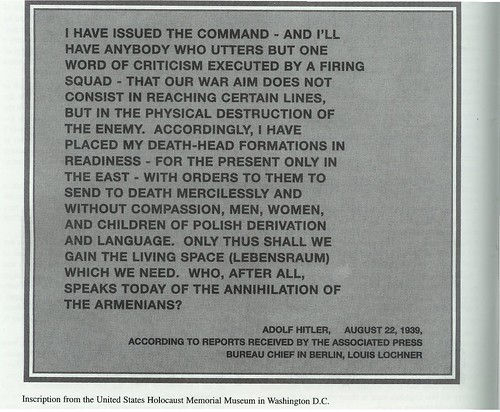
It's not only the Armenians who have been fighting to have the genocide recognized. There are plenty of human rights activists and historians who have looked into the issue and realized that there can't be a neutrality on genocide. When ADL's national director, Abraham H. Foxman, says, "I'm not going to be the arbiter of someone else's history," someone should remind him of the statement made by Adolf Hitler in August 1939, in which he justified his plan to destroy Poland and create a new order by asking, "Who remembers now the destruction of the Armenians?"
ANNA MESCHIAN
Boston

FOR THE LAST several years, I have served as a docent for the Jewish Community Relations Council at the Holocaust Memorial in Boston, and I cannot understand how the Anti-Defamation League's national director can in good conscience state, regarding recognition of the Armenian genocide, that, "We're not party to this, and I don't understand why we need to be made party." The purpose of a Holocaust memorial is not just to remember the Jews who were slaughtered, but also to make us all serve as witnesses to all past genocides and to work together to prevent more genocides. If Watertown is truly to be No Place for Hate, then perhaps it is time that the ADL take an official position regarding the 1.5 million Armenians who died.
RONALD A. GOODMAN
Quincy
read more

2007.08.03 -- Watertown Tab: Letters to the Editor Published on August 3, 2007

Watertown TAB & Press
Fri Aug 03, 2007
Watertown, MA

Letter: ADL's failure to condemn genocide is outrageous
It is shocking to read the hateful comments made by Mr. Andrew H. Tarsy, the regional director of the Anti-Defamation League, in the July 27 TAB & Press (“ADL: Issue of genocide is for Turkey and Armenia to resolve”).
Commenting on the Armenian genocide, Mr. Tarsy said “we expressed an opinion that the issue was one to be resolved between the two countries — Armenia and Turkey.”
Genocide is a human rights issue that concerns everyone. It is an American issue. There are international conventions and laws on the crime of genocide, just as there are tens of resolutions in the U.S. congress that address the Jewish genocide.
Let’s for a moment reword the ADL’s opinion and replace the word “Armenia” with “Jews” and “Turkey” with “Germany.” It would be equally outrageous to propose that the Jewish genocide was one to be resolved between Jews and Germany.
The ongoing crime of genocide in Darfur is a human rights issue that is of concern to everyone. As long as organizations such as the ADL and No Place for Hate fail to condemn them, genocides like the one in Darfur continue. Genocide stops when denial ceases.
Adolf Hitler believed that the world would remain indifferent to the plight of the Jewish people. He reportedly told Nazi commanders before the outbreak of World War II, “Who remembers the Armenians?”
Denial murders the memory of the horrors and the victims. We must always guard against denial and hateful opinions such as that of Mr. Tarsy’s ADL becoming accepted as legitimate discourse. Maybe we can prevent “never again” from becoming an empty saying.
There is No Place For Hypocrisy and the ADL.
Berge Jololian
Cambridge

Letter: Foxman links a noble group with genocide denial
The editorial, opinions, and letters to the editor over the last few weeks regarding the inclusion of “No Place for Hate” in our community are not only interesting, but also an important part of ensuring a world free of genocide.
The Web site of the New England office of the Anti-Defamation League explains that the No Place for Hate Program “empowers communities to respect diversity and prevent and respond to hate crimes in their towns.”
Recent statements, however, by the ADL’s national director Abe Foxman opposing U.S. Congressional recognition of the Armenian Genocide — and worse, Foxman’s use of euphemistic language to deny the Armenian Genocide — runs counter to the fundamental tenets of No Place for Hate.
They also run counter to the ADL’s own charter, which, according to the ADL’s Website states that the ADL’s “ultimate purpose is to secure justice and fair treatment to all citizens alike and to put an end forever to unjust and unfair discrimination against and ridicule of any sect or body of citizens.”
Genocide — whether committed by the Ottoman Turkish government in 1915, Germany’s Nazi Regime in 1939 or the Sudanese Government today — is the most extreme example of hate crime. For the parent organization of No Place of Hate, or rather the national director of that organization, to deny genocide, goes against the basic concepts of tolerance and respect for diversity the organization is working so hard to promote in our communities.
For the sake of its own program credibility in Watertown and throughout the Boston area, the No Place for Hate leadership must speak clearly against genocide denial by properly recognizing the Armenian Genocide and condemning genocide denial in all forms.
Foxman does a disservice to the ADL in associating this noble organization with genocide denial. We can only hope that Boston’s No Place for Hate program leadership will not allow itself to follow in the same disgraceful path.
Sharistan Melkonian
Armenian National Committee of Eastern Massachusetts
Nichols Avenue

Letter: ADL stance is inconsistent with `No Place for Hate'
It is inconsistent for the Anti-Defamation League to sponsor “No Place for Hate” while simultaneously denying the historical truth regarding the Armenian Genocide.
Many Jewish history and genocide scholars, both from within Israel and from without, have written factual accounts of the Armenian Genocide. Moreover, in Turkey, hate crimes against Armenians, Greeks, and other minorities have not ended as is witnessed by the recent murder of Armenian journalist Hrant Dink, and the ongoing persecution of members of his family and staff of his newspaper “AGOS.”
Pearl Teague
Chairperson
Armenian National Committee of Merrimack Valley

read more

PETITION: AN APPEAL TO NO PLACE FOR HATE

We, the undersigned, respectfully request that the No Place for Hate leadership, in keeping with its principles, issue a public statement opposing Turkey's state-sponsored campaign to deny the Armenian Genocide and call on its sponsor, the Anti-Defamation League (ADL), through its National Director Mr. Foxman, to openly and unequivocally acknowledge the Armenian Genocide and support congressional affirmation of this crime against humanity.
The above paper petition was launched in Watertown, Massachusetts on Thursday, Aug 2, 2007. If you or your organization would like to obtain petition forms for circulation, please write to info@noplacefordenial.com .
read more

ANCEM Letter to NPFH-Watertown

August 2, 2007
Dear Sirs:

I am writing to receive clarification regarding the position of the Watertown No Place For Hate (NPFH) concerning the Armenian Genocide and Congressional legislation addressing this issue.

Recent statements published in the Boston Globe, Los Angeles Times and The New Republic by Abraham Foxman, the National Director of the Anti-Defamation League, calling into question the Armenian Genocide and its acknowledgment by the U.S. Congress have been a source of great concern. It is astonishing to us that Foxman, who heads an institution, whose goal is to fight intolerance against all races and religions, would claim ignorance about the Armenian Genocide. It appears to be a willful ignorance. Moreover, his repeated references to the tragedy as simply an "Armenian" concern or "someone else's history" goes against the very foundation of NPFH's community-wide approach to battling hatred, bigotry and intolerance.

Affiliation or acquiescence with Mr. Foxman's unconscionable position on the Armenian Genocide seriously undermines the efforts of the NPFH—a leader in the fight against bigotry and intolerance in Watertown .

In an initial good faith effort to dispel any misunderstandings regarding the NPFH position on this key human rights concern, we respectfully request that the NPFH leadership issue a public statement supporting efforts to oppose Turkey's state-sponsored campaign to deny the Armenian Genocide, expressing support for Congressional Armenian Genocide legislation and requesting that the ADL, through its director Mr. Foxman, publicly and unequivocally renounce its denialist agenda.

We look forward to your reply and working with the NPFH in the fight against intolerance and racism.

Sincerely,
Sharistan Melkonian
Chairperson
Armenian National Committee of Eastern Massachusetts
read more

ANCEM Letter to the Boston Globe

Submitted: August 2, 2007

Dear Editor:

Abraham Foxman's remarks about the Armenian Genocide are disappointing and unconscionable ["Antibias effort stirs anger in Watertown" 8/1/2007]

For the National Director of the Anti-Defamation League (ADL), an organization with a 94 year history of dedication to eradicating anti-Semitism, bigotry and extremism, to plead ignorance about the Armenian Genocide is unfathomable. The facts of the Armenian Genocide are well documented by genocide and Holocaust historians around the world, many of whose writings are available as educational resources on the ADL's own website.

Perhaps more troubling, though, is his argument that by acknowledging the Armenian Genocide one serves as an "arbiter of someone else's history" or his statement that "we're not a party to this and, and I don't understand why we need to be made party." Genocide -- be it the Armenian Genocide, Jewish Holocaust, Cambodian Genocide, or the ongoing genocide in Darfur -- is not an Armenian or Jewish or Cambodian or Sudanese issue. Genocide -- and its denial -- is a scourge on all humanity and only through collective vigilance can it be stopped. That is exactly why Watertown and cities across the U.S. have endorsed programs like "No Place For Hate" -- to raise a united, community campaign against the hatred and intolerance that breeds racism and, in extreme cases, genocide. And that is why a majority of House Members -- including all Members of the Massachusetts Congressional delegation -- today have cosponsored Armenian Genocide legislation (H.Res.106).

Foxman's statements reflect a fundamental disconnect from the core values of "No Place For Hate" and the ADL. His arguments are no different than Turkey's standard diatribe denying the Armenian Genocide. It is unfortunate that he continues to defend an unrepentant perpetrator of genocide for what can only be described as short-term political expediency.

Watertown "No Place For Hate" Co-Chairman Will Twombly got it right. "Not to condemn the genocide and fully recognize it for what it was, I personally find inconsistent with the mission of No Place for Hate," stated Twombly. Anything less than an official public statement by "No Place for Hate" speaking honestly about the Armenian Genocide and calling upon Foxman to renounce his denialist agenda would compromise and render ineffective a valuable organization with a noble mission.

Sincerely,
Sharistan Melkonian
Armenian National Committee of Eastern Massachusetts
read more

2007.08.01 -- Jewish Voice for Peace Letter to the Boston Globe

Submitted: August 1, 2007

To the editor:

Abraham Foxman's contention that his Anti-Defamation League (ADL) should not be the arbiter of history" by acknowledging the historicity of the Armenian genocide ("Anti-bias effort stirs anger in Watertown," Wednesday, Aug. 1) is at best disingenuous, at worst craven self-interest. The ADL has not remained neutral on the issue of the Armenian genocide, as Foxman implies, it has, in fact, lobbied determinedly to keep the U.S. Congress and international bodies from labeling Turkey's acts what they were. If the ADL was true to its original mission and Turkey was not of political importance to Israel's leaders it would surely be at the head of the line in denouncing genocide wherever it exists or existed. Further, if anyone were to side-step the issue of whether the Holocaust really happened by refusing to be "the arbiter of history," Foxman and the ADL would (appropriately) be apoplectic. Watertown and all other cities and towns with "No Place for Hate" programs should sever all ties with the ADL at least until its New England Region assertively denounces its national director's hateful positions.

Martin R. Federman
Co-chair, Jewish Voice for Peace, Boston
read more

ANCEM Letter to the Watertown Tab: Published on August 3, 2007

Letter: Foxman links a noble group with genocide denial
Submitted: July 27, 2007

The editorial, opinions, and letters to the editor over the last few weeks regarding the inclusion of “No Place for Hate” in our community are not only interesting, but also an important part of ensuring a world free of genocide.The Web site of the New England office of the Anti-Defamation League explains that the No Place for Hate Program “empowers communities to respect diversity and prevent and respond to hate crimes in their towns.”

Recent statements, however, by the ADL’s national director Abe Foxman opposing U.S. Congressional recognition of the Armenian Genocide — and worse, Foxman’s use of euphemistic language to deny the Armenian Genocide — runs counter to the fundamental tenets of No Place for Hate.

They also run counter to the ADL’s own charter, which, according to the ADL’s Website states that the ADL’s “ultimate purpose is to secure justice and fair treatment to all citizens alike and to put an end forever to unjust and unfair discrimination against and ridicule of any sect or body of citizens.”Genocide — whether committed by the Ottoman Turkish government in 1915, Germany’s Nazi Regime in 1939 or the Sudanese Government today — is the most extreme example of hate crime. For the parent organization of No Place of Hate, or rather the national director of that organization, to deny genocide, goes against the basic concepts of tolerance and respect for diversity the organization is working so hard to promote in our communities.

For the sake of its own program credibility in Watertown and throughout the Boston area, the No Place for Hate leadership must speak clearly against genocide denial by properly recognizing the Armenian Genocide and condemning genocide denial in all forms.Foxman does a disservice to the ADL in associating this noble organization with genocide denial. We can only hope that Boston’s No Place for Hate program leadership will not allow itself to follow in the same disgraceful path.

Sharistan Melkonian
Armenian National Committee of Eastern Massachusetts
Nichols Avenue
read more

2007.07.26 -- Watertown Tab: Letters to the Editor Published on July 26, 2007

The Watertown TAB
Watertown, MA
www.watertowntab.com

LETTERS
July 26, 2007

Letter: ADL: Issue of genocide is for Turkey and Armenia to resolve

Your editorial “Keep ‘No Place for Hate’” (July 20) is an important statement for why the Watertown community should retain and benefit from the Anti-Defamation League’s program for rejecting hate and bigotry. Watertown is one of hundreds of cities and towns across America that pledged to ADL to be a community where there is “No Place for Hate,” and there is deep commitment to promoting respect and understanding.

Unfortunately, the editorial mischaracterizes ADL on the issue of the Armenian Genocide Bill now before the U.S. House of Representatives Foreign Affairs Committee. Neither ADL nor our national director, Abraham H. Foxman, has lobbied against the legislation. Rather, when asked by media, we expressed an opinion that the issue was one to be resolved between the two countries — Armenia and Turkey.

There may be disagreement with our opinion, but, as you rightly say, getting rid of “No Place for Hate” is not the answer.

Andrew H. Tarsy
New England Regional Director
Anti-Defamation League
**

Letter: Good intentions sometimes fail

I respectfully disagree with your editorial “Keep ‘No Place for Hate’” (July 20). While the intentions of the Town Council were honorable when they adopted the Anti-Defamation League program, there is no way of avoiding that in doing so, they are also supporting that organization and its leader, Abraham Foxman.

His active role in blocking our country’s long-overdue recognition of the Armenian Genocide was an egregious act against Armenians, and it resonates particularly in this community. Watertown has been an “Ellis Island” for Armenians, and current census figures do not account for the thousands in surrounding towns and intermarriages that have ties to our town and the Armenian-American community.

The Town Council reaffirmed its participation in the program when the debate was free speech, and I surely hope that their good intentions have not painted them into a corner. Now that we know that this slogan salts the wounds of not just a small vocal minority, but a very large number in our community, why would we want to continue to inflict that pain?

Keeping the program actually creates or, at least, contributes to hate where there was none. The question is no longer whether the program is a good one, but whether we will stubbornly continue to hurt more people than we help.

Robert Fantasia
Main Street

**

Letter: 'No Place for Hate' does important work

I am writing today to highlight the important work of our local No Place for Hate program. No Place for Hate has worked collaboratively with the Watertown Youth Coalition Peer Leaders for more than two years to sponsor Diversity Day held annually at Watertown High School. Specifically, No Place for Hate provides funding, support, photography and displays, including video interviews with Watertown residents and a large historical, photographic display of Armenian people.

On March 28, the second annual Diversity Day was held at Watertown High School. The Watertown Youth Coalition peer leaders, No Place for Hate, Watertown High School, the Armenian Club at WHS and Wayside Multi-Service Center sponsored the event. More than 23 different languages were listed on a survey given that day, including Cantonese, Punjabi, Serbian, Arabic, Thai, Tibetan, Albanian, Turkish, Japanese, Armenian, French, African, Spanish, Portuguese, Italian and Vietnamese.

I think the importance of this event is summed up in the words of students. Their many wishes for the future included: “I think people should just get along, I wish everyone could look past all these things, say something when intolerance is used, don’t ignore it, tell people that racism is wrong, appreciate differences and see the good, interesting things people can contribute to society and community.” One student summed up Diversity Day by saying simply: “get along.”

In closing, the Watertown Youth Coalition Peer Leaders developed a rich community collaboration with the local No Place for Hate program and worked hard to create a successful Diversity Day at Watertown High School, making WHS a more welcoming environment for young people and contributing to the warmth and openness of the entire Watertown community.

Becket Rhodes
Watertown
Youth Coalition
Peer Leadership Advisor

**

Letter: 'No Place for Hate' should sever ADL ties

By denying the Armenian Genocide, the Anti-Defamation League supports attempts to minimize and cover up this tragedy. Genocide is an internationally recognized hate crime. The No Place for Hate organization should sever its relationship with the ADL until the ADL practices what No Place for Hate preaches.

Joseph Dagdigian
Harvard

**

Letter: 'Potato Famine' was really the 'Irish Holocaust'

I read with interest the letter to the editor from Mr. David Boyajian of Newton about the “Armenian Genocide” (July 6, “ADL works against recognition of Armenian genocide.”) I belong to the Ancient Order of Hibernians and several years back we organized, with several other ethnic groups, to pass a bill to teach in the Massachusetts school system the truth and recorded history of the Armenian Genocide, the Holocaust and the “Potato Famine” of Ireland.

The bill was greatly helped at that time by state reps. Steve and Warren Tolman. The bill was unanimously approved by both committees and sent on to the then Speaker of the House, Tom Finneran. However, the Speaker of the House said he would not approve the bill to be mandatory, even though the vote of both committees was unanimous. It was passed only with the stipulation that if a local School Committee wanted it as part of their curriculum, they could use it. So there it sits, and no one is teaching the truth about these historical events.

Now to me as being of Irish ancestry, when people refer to the greatest human tragedy of the 19th century, where 1 million people died as a “famine” is an insult. We choose to call it “An Gorta Mor” or The Great Hunger. In 1845, a blight hit the potato crop in Ireland, the main food of the Irish table. This blight also hit the main continent of Europe. However, there was enough food in Ireland to feed 4 1/2 times the population, which was about 8 million plus.

Why did the Irish population not get this food that was available? Because it was exported out of the country and mostly to England. This was often done at gunpoint. People were literally dying in the street by the thousands. They couldn’t bury them fast enough. Most were buried in a common grave and lime was poured over them and then covered. Over 1 million died and more than 2 million more left Ireland for foreign countries, out of total desperation. Tens of thousands died on the “Coffin Ships” that sailed the Atlantic. Many who made it here to the United States were sent to quarantine stations where they perished.

Locally, Deer Island is a mass burying place where many are buried in common graves. The population of Ireland at that time was a little over 8 million and it was reduced to a little over 4 million because of An Gorta Mor, and it has never recovered to this day, where the population is still less than 5 million.

This was an “Irish Holocaust” not to be taught in the Massachusetts school system. This is a state where the Irish ancestry is the largest in the USA per capita. It represents about 25 percent of the population. In addition, this state has the second largest Armenian population next to California. It is a shame that both ancestries, Irish and Armenian, are not taught the truth and are ignorant of recorded history. It should be mandatory to teach the truth.

Dick MacDonald
Needham
Former Watertown resident

**

Letter: 'No Place for Hate' is an autonomous local group

In recent weeks, the No Place for Hate Program in Watertown has been the subject of many letters, as well as an editorial in this newspaper (July 20, “Keep ‘No Place for Hate.’) Some of the letters raise important questions about the program, which we would like to clarify.

The No Place for Hate program, originally established in 1999 by the New England Chapter of the Anti-Defamation League in partnership with the Mass. Municipal Association, now includes 65 cities and towns across the state. However, it is very much a local initiative. All program decisions are made within each individual community. In Watertown, we have a broad-based NPFH committee of residents, town officials and community groups.

In planning our programs, we seek to collaborate with other town organizations wherever possible. We have received program grants from Blue Cross Blue Shield through the ADL, from the Watertown Rotary Club and from the Helen Robinson Wright Fund of the First Parish Church. Some of our projects have included: a video and traveling exhibit celebrating multiculturalism in Watertown; assisting the Watertown High peer leaders in presenting their diversity days at the school; co-sponsoring the annual Unity Breakfast on Martin Luther King Jr. Day; and working with the World in Watertown to present two very successful forums on immigration issues.

Currently, the NPFH Committee, in partnership with Project Literacy, has embarked on a new translation project. The goal of this initiative is to provide essential information about local services for non-English-speaking residents, translated into a variety of languages. Information will range from how to get help in an emergency to how to navigate the MBTA. Today in Watertown, there are more than 25 different languages spoken in the homes of public school students, and Project Literacy’s services are in great demand, with long waiting lists of eager students.

Watertown has always been a welcoming community, as witnessed by our large and well-established Armenian and Greek populations, among others. In 1912, the Abraham Lincoln House was established in the East End to provide educational services to immigrants, and particularly to newly arrived Armenians. The No Place for Hate program is one of the ways in which we may continue this tradition, making sure that we remain open and welcoming for our hard-working and highly motivated new neighbors. They are here to stay, and our town will be stronger, richer and more peaceful if every citizen feels valued and respected.

Hopefully hate crimes will not occur in Watertown, but we must work to prevent them. Hatred often arises from fear, and that fear grows from unfamiliarity and lack of understanding. An important role of the NPFH program is to promote interaction and friendship between individuals and groups who otherwise might remain strangers, thus helping everyone to feel included in the community.

No Place for Hate is about basic human decency, about treating one another with respect, and about making an effort as a community to be welcoming to all. It is our hope that we may move forward together in Watertown, united by this vision, with a commitment to making all of our neighbors, regardless of where they are from or how long they have lived here, feel respected and valued. This is the true spirit of community that has, and will continue to make Watertown such a special place to live.

A number of recent letters to the TAB and Press have alluded to the Anti-Defamation League’s position with regard to the Armenian Genocide. The Watertown No Place for Hate Committee, as an autonomous local group, fully recognizes the indescribable tragedy of this horrific event. Our hearts go out to every family member of genocide victims. We hope that all who are inspired by their courage will work locally to prevent hate, and globally to combat and end further devastation in Darfur and other turbulent parts of the world.

For further information about the program, please call 617-926-8130, or Sgt. David Sampson at 617-972-6529.

Will Twombly
Sgt. David Sampson
Co-chairpersons
Watertown No Place for Hate Committee
read more

2007.07.19 -- Watertown Tab: Letters to the Editor & Editorial Published on July 19, 2007

Watertown TAB & Press
Watertown, Massachusetts

Letters
July 19, 2007

The Anti-Defamation League is hypocritical to tout the Jewish genocide while denying the Armenian genocide. This makes all Jewish groups look hypocritical in regards to their Holocaust. Abraham Foxman and his genocide denying ADL are clearly racist and anti-Armenian, with total disregard to issues concerning human rights other than those concerning Jewish.
“No Place for Hate” needs to act rather swiftly before it loses credibility nationwide.
With deep sorrow,

Berge Jololian
Cambridge


***

I don’t understand how the Town Council can continue to support the controversial group known as “No Place for Hate” now that we know it is sponsored by the Anti-Defamation League (July 6 letter, “ADL works against recognition of Armenian Genocide”).
The Anti-Defamation League accuses people who deny the Holocaust of “hate;” but the ADL itself is guilty of the same type of hate when it helps Turkey to cover up the Armenian genocide.
It is blatant hypocrisy.

Lily Ordoubeigian
Concord Road

***

I was disappointed to learn that Watertown’s “No Place for Hate” organization is sponsored by the Anti-Defamation League, which helps Turkey deny the Armenian genocide (July 6 letter “ADL works against recognition of Armenian genocide.”)
This violates everything that “No Place for Hate” claims to stand for.
It is also offensive to all citizens of Watertown, including its thousands of Armenian Americans. I believe that the Town Council must reconsider its endorsement of the “No Place for Hate” organization if it is going to serve as a front for another organization which has selective and contradictory goals.

Levon Karageuzian
Duff Street

**

Editorial: Watertown should keep ‘No Place for Hate’
July 19, 2007

It appears that the national head of the Anti-Defamation League lobbied against Congressional recognition of the Armenian Genocide.
And, understandably, this has stirred up some strong feelings right here in Watertown.

As you can see from a surge of letters to the editor, as seen on the opposite page, the action by the ADL’s national director, Abraham Foxman, has some residents so furious that they are calling for an end to the Watertown’s participation in the ADL-sponsored “No Place for Hate” program.

Town councilors recently reaffirmed Watertown’s participation in the program, which aims to “provide communities with a solid framework for promoting an inclusive environment while fighting all forms of hate and bigotry,” according to its Web site.

But now, some say Watertown must respond to Foxman’s action by pulling the town out of “No Place for Hate.”

More than 8 percent of Watertown residents trace their heritage back to Armenia, according to the Census. The actual number may be higher. Certainly Watertown became a sanctuary for Armenians fleeing the World War I-era attempt by the Turkish government to wipe them out.

Turkey’s government continues to deny that the mass deaths of Armenians were the result of government policy. To Turkey’s great shame, it is still a crime to “insult Turkishness” by calling it what is clearly was: genocide. More than a million ethnic Armenians died in what was without doubt a program by the Turkish government to eradicate Armenians. Hitler publicly admired Turkey’s methods.

The Armenian Genocide bill, House bill 106, is now in the House Foreign Affairs Committee. There’s a similar bill in the Senate. The new Democratically controlled Congress appears to offer the best chance in years of putting the U.S. government on record as calling Turkey to account for its systematic campaign to eliminate Armenians.

So why in the world would the head of the ADL, an organization with a proud history of fighting anti-Semitism and racism, argue against U.S. government recognition of the Armenian Genocide?

Here’s what Foxman said, according to the L.A. Times:
“I don’t think a bill in Congress will help reconcile this issue. The resolution takes a position. It comes to a judgment. The Turks and Armenians need to revisit their past. The Jewish community shouldn’t be the arbiter of that history. And I don’t think the U.S. Congress should be the arbiter, either.”

It boggles the mind that the head of the ADL could actively work against recognition of a genocide, given the centrality of the Holocaust to the ADL’s work.

But Foxman’s line of thought isn’t different from that of other public figures from Secretary of State Condoleezza Rice to a wide range of members of Congress: As a moderate Muslim state, Turkey is an important U.S. ally. And Turkey may be the closest thing to an ally that Israel has among states with a Muslim majority. Pushing recognition of the Armenian Genocide could result in Turkey taking actions against U.S. and Israeli interests.

This “realpolitik” way of thinking envisions Turkish hardliners retaliating by, for instance, shutting down U.S. military bases in Turkey. The thinking goes: Israel still faces an existential threat from its neighbors, so keeping Turkey friendly is a greater good than righting a historical wrong.

But these considerations of geo-politics should be removed from the discussion about whether Watertown should participate in “No Place for Hate.”

While “No Place for Hate” has attracted a vocal minority of people who make the specious claim that it somehow muzzles free speech, the program itself is a good one. It’s a public statement that Watertown stands against bigotry and hate.

“No Place for Hate” was created by the ADL New England Region, in partnership with the Massachusetts Municipal Association. It has virtually nothing to do with Foxman’s national organization.

“The local ‘No Place for Hate’ is very committed to efforts to reinforce tolerance,” said Will Twombly, co-chairperson of the program’s Watertown committee. “We are not in any way part of efforts to deny the Armenian Genocide.”

Watertown shouldn’t pull out of “No Place to Hate” over Foxman’s hypocritical decision to work against governmental recognition of the Armenian Genocide. To do so would be “throwing the baby out with the bath water.”

The goals of “No Place for Hate” track well with the moral imperative to recognize the Armenian Genocide. Put another way, when our friends disappoint us, the solution isn’t to stop being friends. It’s to work to bring our friends around.

Putting pressure on Foxman to reverse his stance is a good thing.

Getting rid of “No Place for Hate” in Watertown isn’t.
read more

2007.07.06 -- David Boyajian's Letter to the Watertown Tab

The Watertown TAB
Watertown, Massachusetts

Friday, July 6, 2007

Letter: "Anti-Defamation League works against recognition of Armenian genocide"

“No Place for Hate” (NPFH) programs, such as Watertown’s, are tarnished by the fact that the Anti-Defamation League (ADL) has authored and sponsored them. The ADL, you see, has made the Holocaust and its denial key pieces of NPFH while at the same time hypocritically working with Turkey to oppose recognition of the Armenian genocide of 1915-23.

This has been known for years.

The Los Angeles Times (April 21, "Genocide resolution still far from certain") for example, reports that ADL’s National Director, Abraham Foxman, opposes Congressional affirmation of that genocide.

Yola Habif Johnston of the Jewish Institute for National Security Affairs acknowledges that “the Jewish lobby has quite actively supported Turkey in their efforts to prevent the so-called Armenian genocide resolution from passing.”

One underlying reason is the Israeli - Turkish alliance.

Opposing affirmation of the Armenian genocide is an affront to all fair-minded people.

How would NPFH and the ADL react if Armenian organizations blocked acknowledgement of the Holocaust?

I say these things with deep sorrow. After all, many distinguished Jewish individuals and organizations, such as the Jewish War Veterans of the USA, support Armenian genocide recognition.

But the ADL’s dishonest policies toward Christian Armenians and their genocide violate NPFH’s own principles.

NPFH is, therefore, ethically obligated to sever its ties to the ADL.

David Boyajian
Newton
read more

2005.09.15 -- Zaman: PM Demands Jewish Support Against Armenians

Zaman Online, Turkey
Sept 15 2005

PM Demands Jewish Support Against Armenians
By Cihan News Agency, Anadolu News Agency (aa)
Published: Thursday, September 15, 2005
zaman.com

Turkish Prime Minister Recep Tayyip Erdogan has received representatives of the American Jewish Committee (AJC), Anti-Defamation League, B'nai B'rith and American Jewish Organizations.

Turkish Prime Ministry Spokesperson Akif Beki announced that Erdogan ahead of the bill on the alleged Armenian genocide to be negotiated at the House of Representatives Foreign Affairs Commission has called on Jewish associations to help Turkey on the issue.

Reportedly, Jewish representatives expressed they have been on Turkey's side so far and they will continue their support.

The Turkish Premier spoke of Turkey's initiatives about so-called Armenian genocide allegations reiterated they opened archives in Turkey, so that everyone can come and make research.

Dealing with the Alliance among Civilizations initiative Turkish Prime Minister emphasized his attribution for the project. The Pakistan-Israel meeting to be held in Istanbul under auspices of Erdogan came to the issue during the talks as well.

Beki uttering the conflict in Iraq was also brought to the issue added that Erdogan emphasized the adoption of a democratic system where all segments were represented by the protection of Iraq's territorial integrity and political unity.

Reminded about Turkey's sensitivities on Kerkuk (Kirkuk) during the meeting, Erdogan also warned that Kirkuk cannot be surrendered to any individual group.

read more

2004.08.12 -- Haaretz: Armenian Lobbyists Are Facing a Lost Cause

Haaretz International
Thu., August 12, 2004 Av 25, 5764

Armenian lobbyists are facing a lost cause

By Nathan Guttman

Activists again failed to obtain U.S. congressional recognition of the Armenian genocide. The obstacles they face include America's ties with Turkey and the Jewish lobby.

WASHINGTON - For a moment it seemed to Armenian activists in the U.S. that they had made progress toward obtaining U.S. congressional recognition of the massacre perpetrated by the Turks against the Armenian people 98 years ago. U.S. Congressman Adam Schiff, a California Democrat, succeeded on July 15 in getting approval from the House of Representatives for an amendment to the Foreign Operations Appropriations bill, which would bar Turkey from using the annual American aid it receives to hire political lobbyists in Washington to lobby against the decision recognizing the Armenian genocide. Ostensibly, a marginal amendment and not terribly important, but in the eyes of supporters of the Armenian cause in the U.S., even approval of a minor amendment is considered an achievement.

The battle to gain recognition of the Armenian genocide by the U.S. Congress is transformed annually into a fight between the small group of Armenian supporters in Congress and the rest of the world - the Turkish representatives and the lobbyists working on their behalf, the administration, the supports of the administration in Congress, and also several of the large Jewish organizations. When the U.S. tries to maintain good relations with Turkey, the price is paid by those who want to see the American Congress include the Armenian genocide in the decision denouncing such actions, Resolution 193, which also recognizes the Armenian genocide as such, approval of which has been delayed.

The minor achievement in Congress, which is now referred to as the Schiff Amendment, did not last long. Republican leaders in the House of Representatives - Speaker J. Dennis Hastert, House Majority Leader Tom DeLay and House Majority Whip Roy Blunt - issued an especially sharply worded statement the day after the amendment was approved, in which they made it clear that the amendment was unacceptable to them and that they would seek to annul it when the Foreign Operations Appropriations bill came before the conference committee that attempts to bridge the gap between the Senate and House of Representatives positions, before a bill is sent to the president for his signature. When the House leadership mobilizes to kill a bill, chances are the effort will be successful and therefore it seems that despite the Schiff Amendment, no one will deduct from U.S. aid to Turkey the sums it uses to finance activities against the resolution recognizing the Armenian genocide.

`The resolution is dead'

Even the chances of House Resolution 193 now seem slimmer than ever, given that at the conclusion of their statement, the House majority leaders declared that "Furthermore, we have no intention of scheduling H.Res. 193, as reported out of the Judiciary Committee in April, during the remainder of this Congress." The practical significance of that is the resolution is a lost cause. Elizabeth Chouldjian, of the Armenian National Committee of America (ANCA), believes there is a still a chance for getting the amendment passed. The organization is currently urging its supporters to call and write to the House of Representatives in order to overturn the decision of the House leadership and nevertheless schedule a vote on the resolution. "We're getting good response in the House of Representatives and have 40 co-sponsors on a similar resolution in the Senate," she said, but history teaches that even interest groups that are stronger than the Armenian lobby have no chance when the administration and the Congressional leadership are working against them. Another Armenian activist openly admitted that "the resolution is dead" and this year again there is no chance of passing the resolution that recognizes the Armenian genocide.

Don't upset Turkey

The main obstacle facing supporters of the Armenian cause in the U.S. and their attempts to gain recognition for the Armenian genocide is the administration's basic position and that of many others, whereby friendship with Turkey is more important than anything else. The Turkish government, via its diplomatic representatives and lobbyists, has made it very clear to the Americans that any recognition of the Armenian genocide will be perceived in Ankara as a slap in the face and will adversely affect ties between the two countries.

So, for example, when France was considering a similar law, the Turks threatened a series of sanctions and in the end recalled their ambassador from Paris for six months. In the U.S., the situation is much more sensitive - the Americans need Turkey as a crucial ally in its region, as a base for U.S. forces and primarily, to maintain relative quiet in northern Iraq. "Our relationship with Turkey is too important to us to allow it to be in any way damaged by a poorly crafted and ultimately meaningless amendment," said senior House leaders in their reaction to the Schiff Amendment. The administration maintains a similar position. The debate does not revolve around the question of whether there was an Armenian genocide or its scope, but around contemporary politics and Turkey's possible reaction if someone upsets them with regard to this issue.

The Jewish community in the U.S. and the Israel issue are also entwined in the pressure campaign preventing approval of the resolution. "The community is certainly a player on this issue," said a key Jewish activist in Washington, who like many others involved in the issue, asked to remain off the record. Representatives of Jewish organizations reported "a sense of discomfort," as one described it, when coming to explain their position on the Armenian resolution; on one hand, the Jews as a community are sensitive to the tragedy experienced by the Armenian people, but on the other hand, there are Israel-Turkey relations to consider. "We have always had a level of uncertainty regarding the balance that should be kept between the moral factors and the strategic interests," one Jewish organization official cautiously explained.

Last year, Jewish organizations, primarily the American Jewish Committee (AJC), have been more active in thwarting the resolution acknowledging the Armenian genocide. This year the politicians managed of their own accord and the resolution will be postponed even without the involvement of Jewish organizations. But a central activists in a Jewish organization involved in this matter clarified that if necessary, he would not hesitate to again exert pressure to ensure the resolution is not passed and the Turks remain satisfied. The same activist said he had received numerous requests in the past to work against the Armenian cause in Congress. "The State Department asked us, other people in the administration did, even the Turkish Jewish community asked us to act on this issue," he said. The prevailing opinion among the large Jewish organizations is that "Turkey's relations with the United States and Israel are too important for us to deal with this subject," according to one community activist who was involved in blocking Resolution 193 last year. The more expansive explanation, offered in meetings and discussions, is that "the Armenian genocide is a matter for historians, not for legislators."

Even though ties between Israel and Turkey are the determining factor in decision-making in the Jewish community, there is also some weight to the matter of definition. The American term proposed in the resolution refers to "genocide" of the Armenians, while the Nazis' acts against the Jews during World War II are defined as "Holocaust." The distinction does indeed exist, but according to many Jewish activists, there are some who feel discomfort over the mention of the Armenian genocide alongside the Jewish Holocaust, for fear of cheapening the concept of a holocaust.

The Jewish community's involvement in the issue of the Armenian genocide is affected by the status of Israel-Turkey relations. One senior organizational official related that during the honeymoon years of Turkish-Israeli ties, the Jewish organizations were more enthusiastic about openly helping Turkey thwart previous Armenian-related resolutions in Congress. Now, he adds, since ties have cooled off somewhat, many Jewish activists are trying to lower their profile in this matter. The organized Jewish community in the U.S. has close ties with the Turkish government and one of Turkish Prime Minister Racep Tayep Erdogan's senior advisers even promised recently at a Washington meeting with a Jewish audience that Erdogan's criticism of Israel was misunderstood and that Turkey will do everything to restore ties to the way they were.

Armenians for Kerry

The insistence of the administration and Congressional Republicans to bar the resolution on Armenian genocide does not make President George Bush very popular among Armenians on the eve of elections. One of the large Armenian organizations in the U.S. has already publicly endorsed Kerry and the Democrats have two groups of Armenians for Kerry working for them. So far, no Armenian group has voiced support for Bush. But the Armenian community's electoral power is not significant. There an currently an estimate 1-1.5 million Americans of Armenian descent, but most are second, third or fourth-generation immigrants and therefore, not all of them vote based on the candidates' views on faraway Armenia. "There are those who base their decision on the Armenian issue, those who vote only based on their political views and those who vote based on different reasons altogether," explained Ross Vartian, the executive director of the Armenian Assembly of America.

However, the Armenian community has also kept track of President Bush's record. He promised in his 2000 election campaign to recognize the Armenian genocide and after his election worked to thwart such resolutions; he allocated a smaller amount of foreign aid to Armenia than he had recommended to Congress and favored issues relating to Azerbaijan over Armenian ones; and the Armenians in the U.S. were insulted when Bush's administration announced that Armenians residing in the U.S. would be required to register at the offices of the Immigration and Naturalization Service, as foreigners from Arab and Muslim countries were required to do after September 11. Following pressure from the community, the decision was retracted after 48 hours.

Next year, the world will mark the 90th anniversary of the Armenian genocide. Activists in the U.S. hope the international pressure and perhaps also the results of the U.S. election will enable them to obtain approval of the resolution recognizing the Armenian genocide in the next session of Congress. Past experience shows that the chances of that happening are slim.

read more

1998.03.26 -- Jewish Journal: ADL's Zakim Regrets Offense to Armenian Community


ADL's Zakim Regrets Offense to Armenian Community

By JUDITH KLEIN
Jewish Journal Staff
Thursday, March 26, 1998

"I regret if any Armenian - or anyone in the community - was offended or made uncomfortable," New England Anti-Defamation League Executive Director Leonard Zakim said this week in an interview with The Jewish Journal, referring to a November 8 ad in the New York Times. The ad, paid for by ADL, the American Jewish Committee, and the American Jewish Congress, congratulated Turkey on its 75th anniversary as a republic, and thanked the Turkish government for its long-held support of Jews and the State of Israel.

The ad drew criticism from many Armenians and Jews because it praised Turkey for its "democratic and secular ideals" (see Jewish Journal editorial and article in November 13 issue and letter to the editor and op-ed piece in this issue). Critics such as Harvard Professor James Russell, himself a Jew who teaches Armenian studies, were appalled by the ad's content since Turkey has never acknowledged the systematic genocide of Armenians living within its borders in the early part of the century. Unlike modern Germany, modern Turkey has made no reparations and still refuses to admit the historically documented events.

The ad notwithstanding, Zakim vowed the continued support for the inclusion of the Armenian Genocide in studies covered by ADL-sponsored Holocaust education. As he explained, Holocaust education in this country offers many students the only exposure they will ever have to the facts of the Armenian Genocide. He alsoemphasized the commitment of all three organizations to bringing human rights issues to the table in dealings with the nation of Turkey. "The ADL and the other Jewish organizations believe that through the continually improving relationship between Israel and Turkey, the opportunity for dialogue about important issues like human rights and the need for Turkey to further democratize will be more effectively raised.".

Zakim referred to Abraham Foxman, national ADL director, saying that since Foxman is a Holocaust survivor himself, he "is extremely sensitive to the issues of what happens when people stand by, when they don't acknowledge their past, and they don't deal with the issues that remain today." However, Foxman's own remarks to The Jewish Journal were that Turkey "has a magnificent history of tolerance" and the conflict is"between the Armenians and the Turks. They will hopefully someday resolve it." These statements were viewed as inflammatory and myopic by some in the Jewish and Armenian communities.

Both critics and supporters of the ad acknowledge the crucial support Turkey has given to Israel, the only democratic country in the Middle East, and understandthe strategic role Turkey has played in Israel's security. However, many agree with Harut Sassounian who, in the most recent edition of The Armenian Mirror-Spectator, published in Watertown, lambasts the three organizations for placing the ad, writing "these Jewish groups are distorting the facts about Turkey; supporting one of the worst violators of human rights in the world; encouraging the Turkish denials of the Armenian Genocide, thereby undermining their own credibility in countering the revisionists of the Holocaust; offending thousands of sensible Jews around the world who must be disgusted by the immoral public stand of these three Jewish groups; and unnecessarily antagonizing the Armenian-American community and Armenians everywhere against Jews."

read more

2005.04.22 -- The Jewish Week: "The Hidden Holocaust"

(04/22/2005)
‘The Hidden Holocaust’
On anniversary of 90-year-old genocide that paved the way for the Final Solution, campaign for recognition draws limited attention in the Jewish community.
Steve Lipman - Staff Writer

“Who, after all, speaks today of the annihilation of the Armenians?”

Adolf Hitler, to his generals,

before the invasion of Poland in 1939

In the coming days, a people nearly annihilated during the last century will pause to remember its losses.

In commemorations here, in Jerusalem and in other cities around the world, relatives of survivors will discuss painful memories, members of the clergy will offer prayers for the victims and leaders of the dispersed community will call for justice. Historians will reflect on a legacy of hatred that led to mass killings. Stories of brutality and statistics about the murder of a third of a people will be cited.

And hardly a Jew will be present.

The people who died in what has come to be called “The Hidden Holocaust” are the Armenians, Indo-Europeans with roots in the area between the Caspian and Mediterranean seas. They lived for two millennia, until their national tragedy, as citizens in the Ottoman Empire, which fell when Turkey was on the losing side in World War I.

The country of Armenia — the first Christian nation, formerly a republic in the Soviet Union, independent since 1990 — now occupies only 10 percent of the Armenians’ historic homeland, the rest of which is part of neighboring Turkey.

April 24, this year the first day of Passover, is alternately known as Martyrs’ Day or Genocide Commemoration Day. It marks the start of the planned destruction of the Armenian community in Turkey 90 years ago during WWI.

Of the 2 to 2.5 million Armenians there on the eve of the war, an estimated 1 million to 1.5 million were killed by Turkish soldiers and sympathetic Kurds in a campaign that peaked in 1915-16. The carnage lasted sporadically until 1923 and the ascension of Kamil Ataturk, who did not share an animus toward Armenians.

The Armenian losses in those years represented at least a third of their total population in the world — the same percentage as the Holocaust took from the Jewish people.

Front-page news in the 1920s, largely forgotten in the West within a decade, as Hitler’s documented 1939 statement testified — his words are inscribed on a wall of the U.S. Holocaust Memorial Museum in Washington, despite Turkish pressure — the Armenian experience was overshadowed by the Six Million victims of the Shoah. Holocaust survivors’ efforts to remember the Six Million and obtain reparations served as a model for the Armenians’ belated campaign for recognition.

Historians call the slaughter of Armenia “the forgotten genocide.” Israeli historian Israel Charny called it “a dress rehearsal for the Holocaust.” Raphael Lemkin, the Polish-born Jewish lawyer who coined the term genocide in the 1940s, did so in part on the basis of what happened to the Armenians.

Each year the Jewish and Armenian communities commemorate their 20th century tragedies within a few weeks of each other, but few members of one group attends the other’s events.

“We finally came to the conclusion that we were not going to get participation of the establishment Jewish organizations,” says Samuel Azadian, a longtime leader of the local Knights of Vartan fraternal group that has organized the April 24 Times Square memorial ceremony for 19 years.

This year that’s 11 days before Yom Ha-Shoah, Holocaust Remembrance Day.

The parallels between the Armenian Genocide and the Nazis’ Final Solution are chilling, but the issue of the Armenian Genocide and Armenian efforts for international acknowledgement of their tragedy has received little support from the organized Jewish community.

The Armenian Genocide issue presents the Jewish community with a classic conflict: realpolitik (Turkey is a strategic ally of the United States and Israel) vs. ethics (sympathy for an oppressed minority).

Realpolitik has triumphed, and Armenians recognize this.

“Jews and Armenians are linked forever by Hitler,” Armenian Foreign Minister Vartan Oskanian said during the UN’s recent special assembly marking the 60th anniversary of the Auschwitz liberation. “After Auschwitz, one would expect that no one any longer has a right to turn a blind eye or a deaf ear. As an Armenian, I know that a blind eye, a deaf ear, a muted tongue perpetuate the wounds.”

While Jews traditionally participated in disproportionate numbers in such causes as civil rights and South Africa’s anti-apartheid movement, “I have not seen any major involvement of the Jewish community in this issue,” says Haik Gugarats, assistant to the Armenian ambassador in Washington. “It’s surprising.”

Doug Geogerian, director of the Eastern Region of the Armenian National Committee, adds: “We don’t really understand; we’re a little surprised.”

Veteran Israeli politician Yossi Sarid, who as education minister declared at a Genocide commemoration ceremony in Jerusalem’s Old City in 2000 that “for many years, too many, you were alone on this, your memorial day,” will attend an international conference in Yerevan, Armenia’s capital, on April 24 as a private citizen.

“As opposed to many other nations, Israel has never recognized the murder of the Armenian people, and in effect lent a hand to the deniers of that Genocide,” Sarid wrote in a recent essay in Haaretz. “The Israeli Foreign Ministry, and not only it, is always afraid of its own shadow and thus it casts a dark shadow over us all as accomplices to the ‘silence of the world.’ ”

The Genocide — 20 years after an estimated 200,000 Armenians were killed during the reign of Turkey’s Sultan Abdul Hamid II — was carried out by the Ittihad government that took power in 1913. The Ittihad claimed it feared the “infidel” Armenians, the only remaining major Christian group in the Muslim Ottoman Empire, taking up arms for Russia, Turkey’s enemy in WWI.

Already the Armenians “were lobbying for basic guarantees, for civil rights,” says Peter Balakian, an English professor at Colgate University and author of two books with an Armenian theme.

Like the Jews in Nazi Europe, the often prosperous Armenians, pilloried as a Fifth Column, earned the enmity of the majority population, often former neighbors and co-workers. Like survivors after World War II, Armenians tried to put their recent past behind them.

Like the Jewish community today, the Armenians face a problem of keeping the memory of their tragedy alive after the last survivors die.

In 1915, under the cover of war, Armenian soldiers in the Turkish army were disarmed and conscripted into labor battalions. On April 24, 1915, Armenian political and intellectual leaders were arrested and killed. The remaining Armenians — mostly women, children and elderly men — were rounded up by army units composed of violent criminals released from prison.

The Armenians were marched to what they were told would be new homes in the desert hundreds of miles away; most of the captives were killed along the way, or they starved to death, or they were fatally beaten upon arrival. Some were herded into caves and burned alive, or placed on barges that were sunk on the Black Sea, or thrown into gorges.

Reports of rape and theft were common.

James Russell, professor of Armenian studies at Harvard University, calls the Turks’ treatment of the Armenians during WWI “the model that Hitler used.” Rudolf Hess, Hitler’s deputy, was among the German soldiers stationed in Turkey during the Genocide, Russell points out. “Germans assisted the Turks logistically,” he said.

Turkish denials of responsibility offer “a picture of what might have happened [after World War II] if Germany had not been held to account or if Germany had not been defeated,” Russell says.

Henry Morgenthau, the American ambassador in Constantinople during World War I, said in his memoirs that Turkish leaders made no attempt to deny reports of the violence against the Armenians.

“One day I was discussing these proceedings with a responsible Turkish official, who was describing the tortures inflicted,” Morgenthau wrote. “He made no secret of the fact that the government had instigated them, and like all Turks of the official classes, he enthusiastically approved this treatment of the detested race.”

“The great powers did little to prevent the mass murder of the Armenians,” Israeli historian Yair Auron writes in “The Banality of Indifference: Zionism and the Armenian Genocide.”

“Germany, an influential ally of Turkey, although able to do much to stop the murders, had no interest in doing so and was involved directly and indirectly in the Armenian Genocide,” Auron writes. “England and France remained on the sidelines. The United States, and Ambassador Morgenthau in particular, tried to help by diplomatic and monetary means, limited by the fact that the U.S. was neutral during most of the war.”

In Turkey, only Damad Ferit Pasha’s government immediately after the war was forthcoming about the massacres, holding war crimes trials that condemned to death the architects of the Genocide, who had fled the country.

While now-independent Armenia and activists in the Armenian community abroad seek Turkey’s recognition of the Genocide – Turkish governments since the 1920s have denied that genocide occurred, have claimed that the number of victims is exaggerated, have attributed the deaths to disease and famine, have claimed Turks were provoked by attacks by Armenians, have opposed artistic or political efforts to document the tragedy, and have refused to consider the type of reparation payments made by Germany after World War II to Israel and individual Holocaust survivors – the government of Israel and many prominent Jewish organizations in the United States have challenged Armenian claims about their early 20th-century history and have lobbied on behalf of Turkey.

“It’s a wrong-headed view,” says Dr. Robert Jay Lifton, visiting professor of psychiatry at Harvard Medical School and author of “The Nazi Doctors.”

“Often in official Jewish groups there can be insensitivity to others’ suffering,” says Dr. Lifton, who has written his support of the Armenian cause.

The Turkish Embassy in Washington, the Israeli Consulate here, and major Jewish organizations contacted by The Jewish Week did not respond to requests for comment on this issue.

Few Jewish schools in Israel or abroad teach about the Genocide, few rabbis preach about it, few Holocaust institutions pay more than passing attention to the subject.

“Yad Vashem’s mandate is to keep the memory of the Holocaust alive,” a spokesman for the Holocaust memorial center in Jerusalem says. “As such we are dedicated to educating, researching, studying and memorializing the Shoah. However, in the course of our educational and research activities, other instances of genocide, ethnic cleansing and mass murder are raised, including the case of Armenia.”

“It is a Jewish issue and should be a Jewish issue,” says Yair Auron, the Israeli historian who has written two books about the Armenian Genocide. “The world committed genocide before the Holocaust.

“We have to be with the Armenians on their memorial day,” says Auron, who attends the annual commemoration in Jerusalem. “We have to be at the front of the struggle for recognition of the Genocide.” Otherwise, he says, “We’re doing exactly what the deniers of the Holocaust do.”

Israel’s small Armenian community, based in the Armenian Quarter of Jerusalem’s Old City, sponsors a commemoration ceremony there each year on April 24. Few Israelis attend.

In this country, while most major Jewish organizations have distanced themselves from the Armenian Genocide issue, a few groups, notably the Reform movement’s Religious Action Center, and individual Jewish politicians and intellectuals have lobbied for recognition of the Genocide, Armenian and Jewish spokesmen agree.

“You can’t be silent when you see injustice,” says Rabbi David Saperstein, director of the Religious Action Center.

“Armenian community leaders ask me about this,” says Rep. Adam Schiff, a three-term congressman from California who represents a district with a large Armenian population and serves each year as a sponsor of a non-binding resolution that urges Turkey to admit its past.

“There is a sense that the Jewish organizations lobby actively against the resolution,” Schiff says.

The apolitical Joint Distribution Committee, which assists Armenia’s small Jewish community, provided humanitarian aid when a devastating earthquake struck the country in 1988.

Besides Schiff, and Morgenthau, who alerted the American government to the Genocide, individual Jews associated with the Armenian cause include Franz Werfel, a Czech-Jewish novelist whose “The Forty Days of Musa Dagh,” about Armenian resistance to the Genocide, was passed from hand to hand as inspiration among Jewish resistance fighters in World War II ghettos; New York filmmaker Andrew Goldberg, who has produced three documentaries about aspects of Armenian life and is working on a major project about the Genocide that will appear on PBS within a year; and Harvey Weinstein, who, as president of Mirimax, agreed in 2002, despite reported threats from Turkey, to distribute “Ararat,” a film centered around the Genocide.

“Some of the strongest defenders of the Armenians are the Jews” – individual Jews, not heads of Jewish organizations, says Holocaust historian Michael Berenbuam, who has written and spoken extensively on the subject.

“This was a sense of tzedakah for me … a sense of justice,” Goldberg says.

Weinstein, who had not heard about the Genocide until he read the Ararat script, said he agreed to back the project because “the denial of the Armenian Holocaust reminds me of the denial of our own Jewish Holocaust.”

Weinstein “felt it was time to tell the story,” The Los Angeles Times reported. “Having lost eight relatives at Auschwitz, Weinstein related well to the subject.”

The Jewish community has been cautious about embracing the Armenian Genocide issue, observers say, for several reasons. The two primary ones are:
• Pressure by Turkey. Turkey, a political, economic and military ally of Israel, was the first majority-Muslim nation in the Middle East to establish diplomatic relations with Israel. A refuge for endangered Jews from the Inquisition to the Holocaust, the country is hospitable to the 27,000 Jews who still live there.

Turkey consistently challenges any Armenian assertions of Turkish responsibility for a genocide. As far back as the 1930s, it pressured the State Department to block an MGM movie version of “The Forty Days of Musa Dagh.” In 1982 Turkey, according to many media reports, pressured Israel – with threats against the safety of Turkish Jews and indications that it might close its borders to Jews fleeing Iran—to cancel an academic conference on genocide that was to include references to the Armenian experience; a scaled-down gathering was eventually moved from Jerusalem to Tel Aviv.
• The uniqueness of the Holocaust. Many protectors of the Holocaust’s legacy resist attempts to compare the scope of the Shoah to any other mass extermination of a people, feeling that references to such examples as Rwanda, Cambodia or Sudan would diminish the Jewish suffering’s unique status.

The Turkish Daily News in 2001 quoted Shimon Peres, then Israeli foreign minister, as saying, “We reject attempts to create a similarity between the Holocaust and the Armenian allegations. Nothing similar to the Holocaust occurred. It is a tragedy what the Armenians went through but not a genocide.”

“We are teaching the Holocaust in too particularistic a way,” Auron says.

What do the Armenians want?

“We want Turkey to acknowledge the genocide,” Haik Gugarats of the Armenian Embassy says. “All we want from Turkey is the establishment of normal diplomatic relations and the opening of borders.”

Armenia has no territorial or monetary demands, Gugarats says.

“The Turks feel they are unjustly accused,” says Taner Akcam, a Turkish historian and sociologist who is a visiting professor at the University of Minnesota. He is among a handful of Turkish scholars to challenge his homeland’s denial of responsibility for the Genocide.

Though Turkey’s leadership since the 1920s had no direct ties to the slaughter of the Armenians, “some of the founders of the state were members of the party who organized the Genocide,” Akcam says. “The Turks glorified these people as founding heroes.”

Admission of Turkey’s role in the genocide would “question the very foundation of the state,” he says.

Armenian- Americans tell of being raised on stories of the Genocide, like American Jews who heard about the Holocaust while growing up. But the Armenian Genocide did not become a public issue in the Armenian community for a few generations because émigrés here and in other countries lacked the numbers or political clout of Jewish Holocaust survivors who raised public consciousness of the Shoah, starting in the late 1970s.

“After any genocide, the victims don’t like to talk about it – it happened after the Holocaust,” Gugarats says.

Thousands of people, including politicians, are expected to attend Sunday’s memorial ceremony in Times Square. As Turkey seeks membership in the European Union, demands by EU countries, especially France, that Turkey admit responsibility for the deaths of Armenians during the Genocide will focus increased attention on the subject. And the recent $20 million settlement by the New York Life Insurance Company to descendants of Armenians who held insurance policies at the turn of the last century adds to the historical record.

In recent decades the European Parliament, the UN Committee on Human Rights, the Vatican and several European governments and scholarly organizations have acknowledged the Armenian Genocide. In June 1998 the Association of Genocide Scholars defined the Armenian tragedy as the 20th century’s first genocide.

Israel took a neutral position until 1994, when Deputy Foreign Minister Yossi Beilin declared in the Knesset that “it was not war. It was most certainly massacre and genocide … We will always reject any attempt to erase its record, even for some political advantage.”

Apparent Jewish indifference to the issue has drawn Armenian criticism, and, three years ago, a protest rally outside the Israeli Consulate in Los Angeles.

The Armenian National Committee in 2002 criticized “nine major Jewish organizations” – including the American Jewish Committee, the American Jewish Congress, the Anti-Defamation League, and Hadassah – for signing a letter that urged President Bush to provide Turkey with economic and military aid.

The letter, the committee said, “appears to represent a retreat from the Jewish American community’s proud tradition of standing up for human rights, universal values, and the cause of international justice.”

Next year, the Jewish and Armenian communities will be closer, symbolically – Yom haShoah and Genocide Commemoration Day occur on consecutive days in 2006.

read more